Extensions SEO Autopilot · Grow
Every week, an article someone is actually searching for.
SEO Autopilot is the part of Content Studio that writes on your own website. It looks for questions with real demand, writes the article in five stages, has it checked by a second model and publishes it on your domain. At a pace search engines consider normal.

- On your domain
- Second model checks
- Pace like a human
- DE, EN, FR, IT
Who we built SEO Autopilot for
For businesses that know blog articles bring customers, and still have not written one in months.
The practice that answers questions
"What does a dental cleaning cost?", "How long does a root canal take?" Questions your customers ask the search engine before they call. Each gets an article that gives the answer and names your practice.
The shop whose customers need advice
Materials, care, sizes, comparisons. Articles that lead to the product, not only to knowledge. The autopilot links from the text to your product pages, with anchors from the body copy.
The company in three language regions
German as the base, then French and Italian, checked. Every language version on the same website, with the right cross-references between them.
How it works
Eight steps, each in the code. The autopilot is a machine with rules, not a writer with moods.
Search terms with real demand
Two passes: the first suggests around 25 new questions, starting from what your website already covers. The second scores each from 0 to 100 by relevance, demand and contribution to your topic. You see the list and approve.
Inform before selling
About two thirds of the topics answer questions, one third targets purchase intent. And the autopilot may not propose a topic again with a swapped synonym: ten near-identical articles do more harm than good.
Five stages per article
Outline, sections, meta and internal links, image, check. Every hour, an article moves one stage forward. If something breaks off, the stage stays put and is picked up again. Nothing is lost.
A different model checks
The reviewer is a different model family from the writer. It gives 0 to 100 points; below 70 the article fails. Invented facts, a near-identical title or the wrong season are an immediate fail. The autopilot then rewrites once, after that it gives up and reports it.
Links from the text, schema from the code
Three or more internal links per article, each with an anchor that appears word for word in the paragraph, each target page at most once. The structured data for search engines is built by the code, not by the model. So no broken markup.
A pace that does not stand out
New websites start with two articles in week 1, four in weeks 2 and 3, then at most seven per week. A daily cap prevents everything appearing on one day. Search engines see a website that writes regularly, not one that dumps content.
Translated, checked, cross-referenced
German is the base. English, French and Italian are created from it, one translation per hour, and checked. Every language version references the others.
Published where your website lives
Seven adapters: WordPress, Shopify, Ghost, Webflow, a webhook for everything else, our hosted variant and your Ambernord website. Where the adapter can rewrite an article, a correction is simply pushed after it.
How a month with SEO Autopilot runs
Connect
We attach your website, store your facts and your tone from the voice profile, and set how many articles per week you want.
Approve topics
You receive the scored list of search terms. You strike what does not fit, and approve. Ten minutes.
The autopilot writes
One stage every hour. After the check, the article appears on your website, with image, meta, links and structured data. The translations follow.
You see the usage
Every article is listed with its cost in the balance. You see how many articles were created and what they cost. You set the caps yourself.
Under the hood
SEO Autopilot is a module of Content Studio and shares its rules: balance, caps, log. The numbers are counted from the code.
Fails closed
If the reviewer has no access, the article counts as blocked, not as passed. A reviewer that waves things through during an outage would not be one.
One stage per hour, on purpose
Long articles are created over hours, not in one go. If a stage breaks off, the job stays put and is picked up again the next hour.
Duplicate topics are rejected
Before an article is created, the autopilot checks whether the topic or a near-identical title already exists. Two reasons to reject, both logged.
The image is a bonus, not a condition
If the image fails, the stage is marked as skipped and the article still goes to review. An article without an image is better than no article.
Costs are known before the start
The autopilot runs from the same balance as Content Studio. Before every stage the estimate is reserved, afterwards the difference is credited back. Three caps, per run, day and month.
Your domain, your article
Publishing happens on your website. If an article is additionally shown on an aggregate page, it points to the original on your site via canonical. The search engine credits it to you.
Build-out
What we are still building
The autopilot writes and publishes today. Three things are added next, in your project at a fixed price.
Feedback from Search Console
Which articles are found and for what, straight from Search Console back into planning. Today you see the usage, not yet the clicks.
More adapters
Typo3, Joomla and other systems that run through the webhook today get their own adapter with a correction function.
Required image on request
If your blog should not appear without an image, we make the image a condition and let the article wait instead of publishing it without one.
What you see
The queue, an article with its review report, and the topic list. Three views from Content Studio.

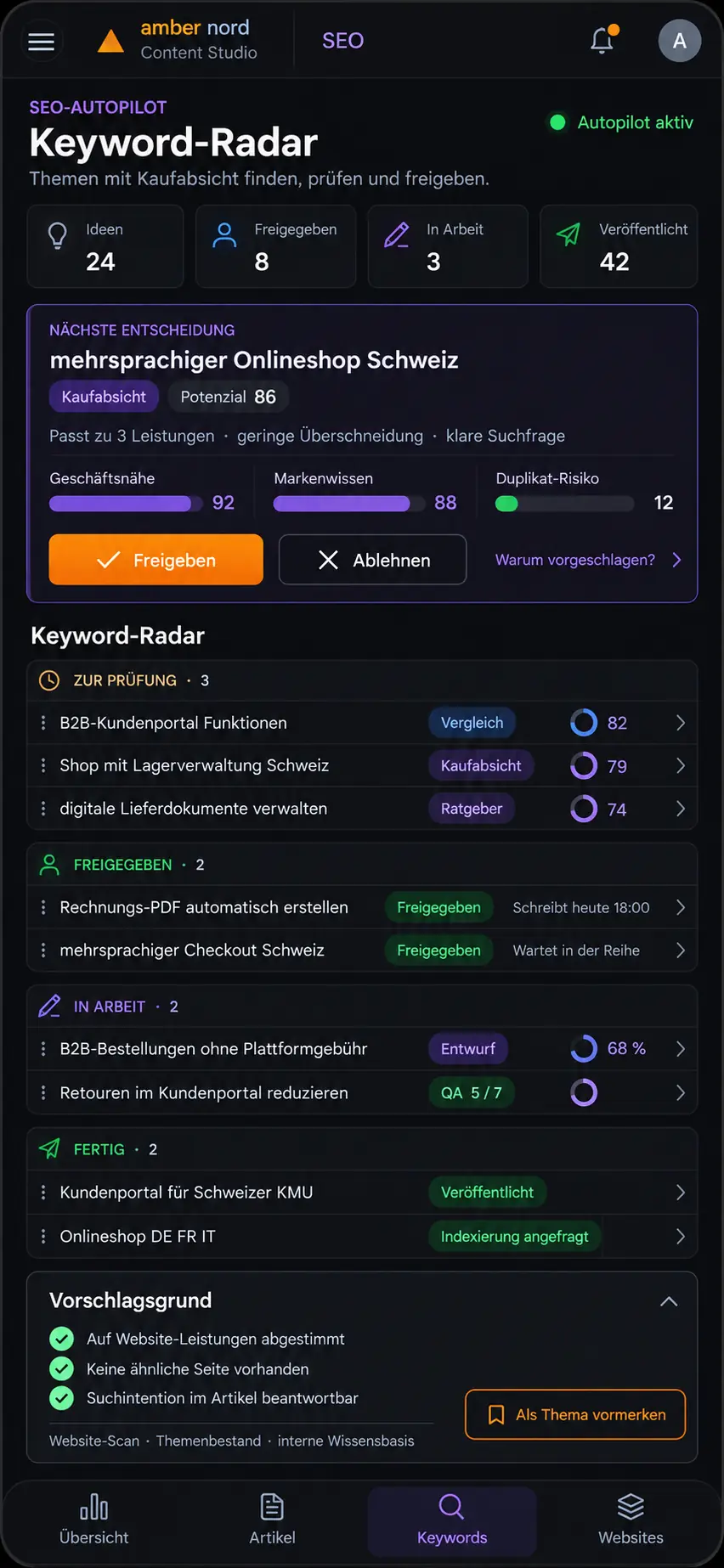
From the balance, no subscription
SEO Autopilot runs from the same balance as Content Studio. An article costs a different amount depending on length, image and translations; you see the amount with every article. Connecting your website and setting up voice and facts is a fixed-price project in the concept.
Balance
1 token = 1 cent
Fixed-price setup in the concept · website from your web package
Request SEO AutopilotQuestions about SEO Autopilot
Search engines rate whether an article answers a question well, not who wrote it. The reviewer has exactly one main job: to reject text that sounds like mass-produced AI. On top of that come your facts, your tone and a pace a real editorial team could keep up.
Yes. You can set the autopilot to file articles as drafts for you to approve. Or you let it publish directly after a passed review and look through the week in the calendar. Both are a setting, not a decision forever.
Invented facts are an immediate fail for the reviewer, regardless of the score. If something still gets through, you correct the text, and the autopilot pushes the correction to all adapters that can rewrite an article. For the others, we apply the correction by hand.
More extensions
What question do your customers ask before they call you?
Write to us with your website and three questions your customers keep asking. Within 48 hours you receive a topic list as a sample and a concept with a fixed price.