Extensions B2B Portal · Run
Four companies, one order, no email chains.
Supplier, platform, carrier and customer work today with emails, attachments and spreadsheets, and nobody knows which version applies. The B2B Portal puts the whole process in one place: enquiry, quote, order, production status, shipping, quality certificates, invoices. Each party sees exactly what it is allowed to see.
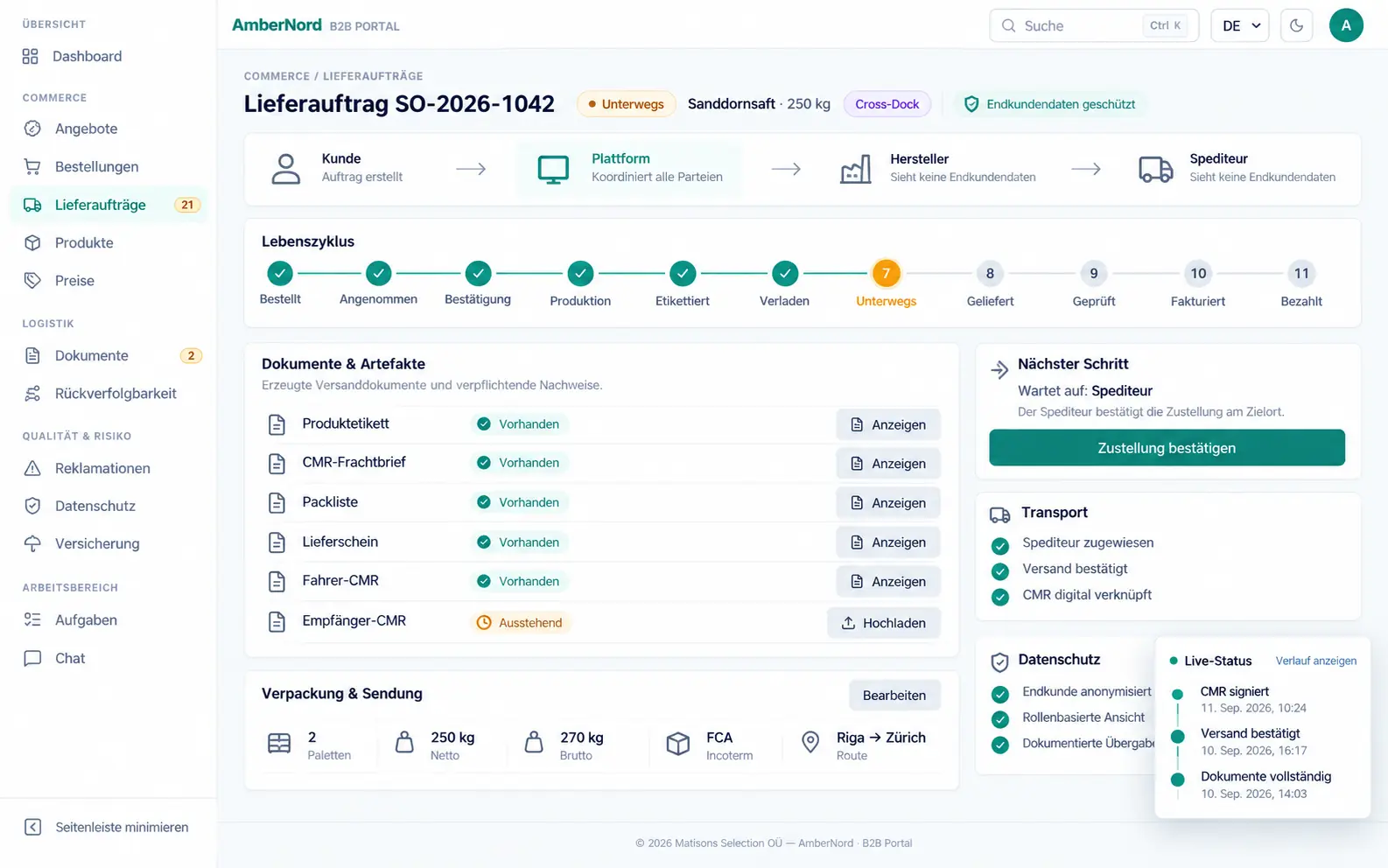
- Four parties, one process
- 11 roles, four tenant types
- Supplier never sees the end customer
- 495 automated tests
Who we built the B2B Portal for
For trading chains where more than two companies are involved in one order. We built it for our own raw-material trading in food, with batches, certificates of analysis and customs.
The supplier who produces and does not have to sell
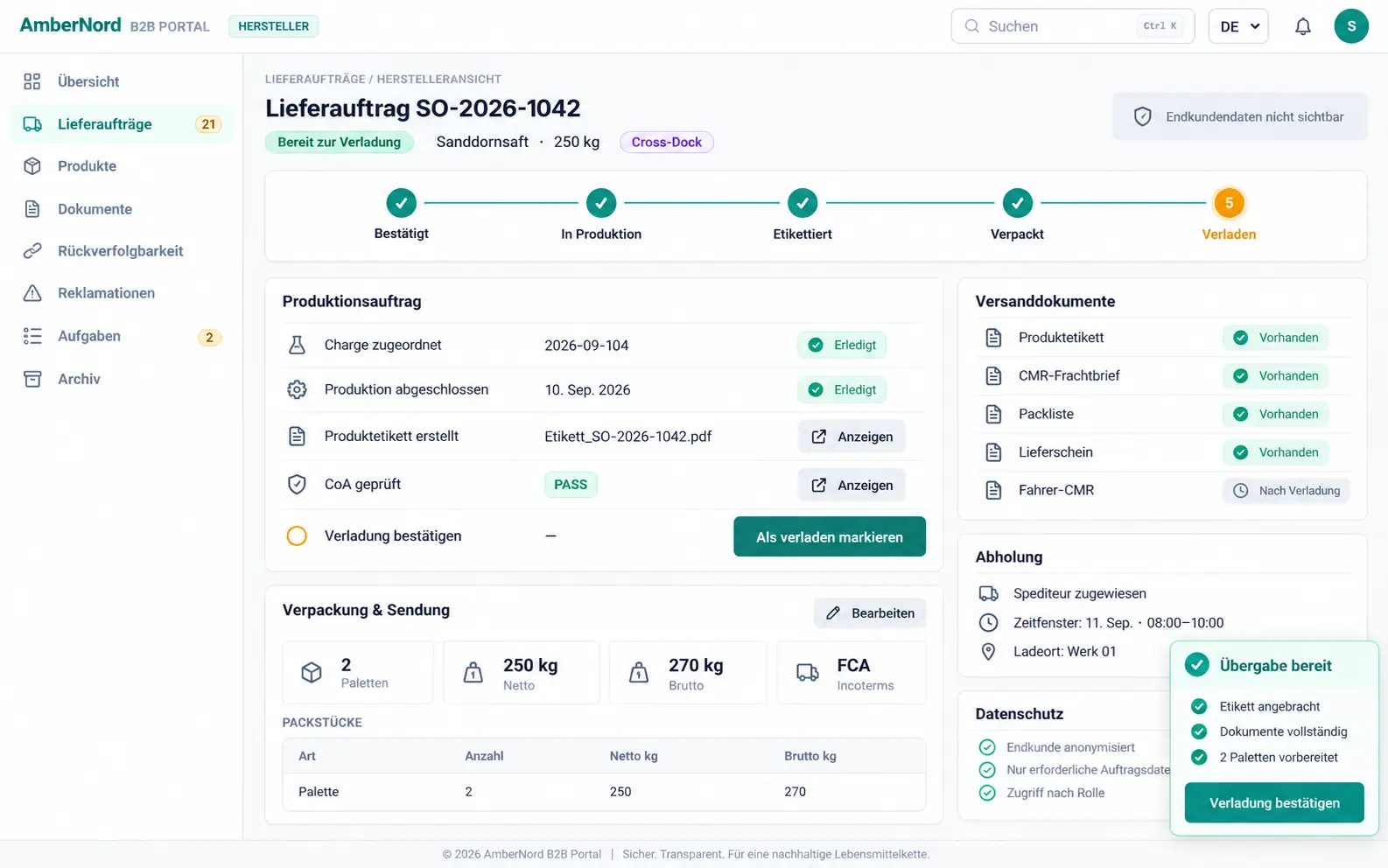
They see orders, quantities, specifications and dates, report production status and upload certificates of analysis. Who buys in the end and at what price, they do not see. The portal shows them only what their work needs.
The trading platform between factory and customers
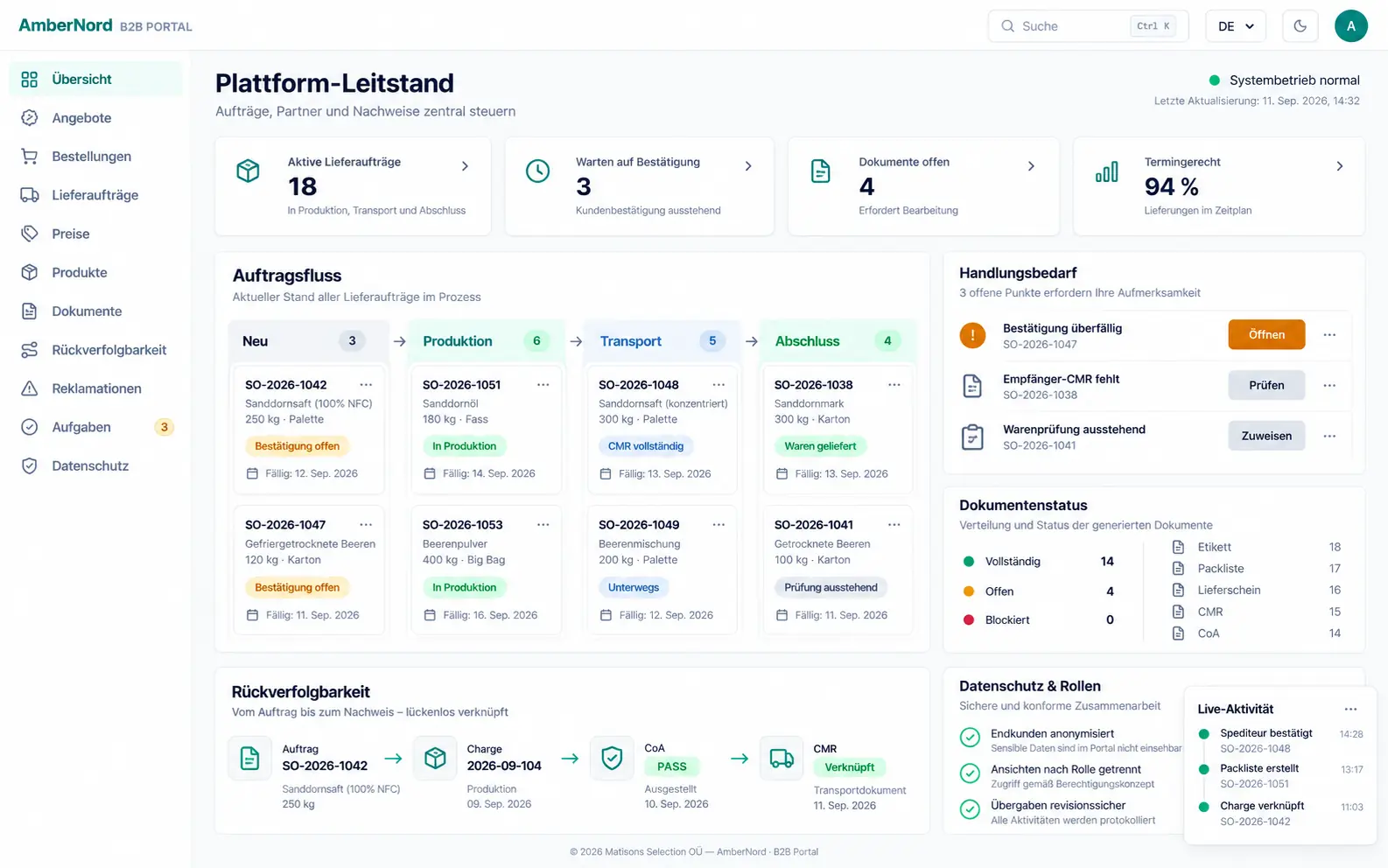
It brokers, bundles and carries the responsibility. It sees everything: purchasing, sales, margins, deadlines, complaints. Supplier and customer meet only through it.
The carrier that needs only one thing: the delivery
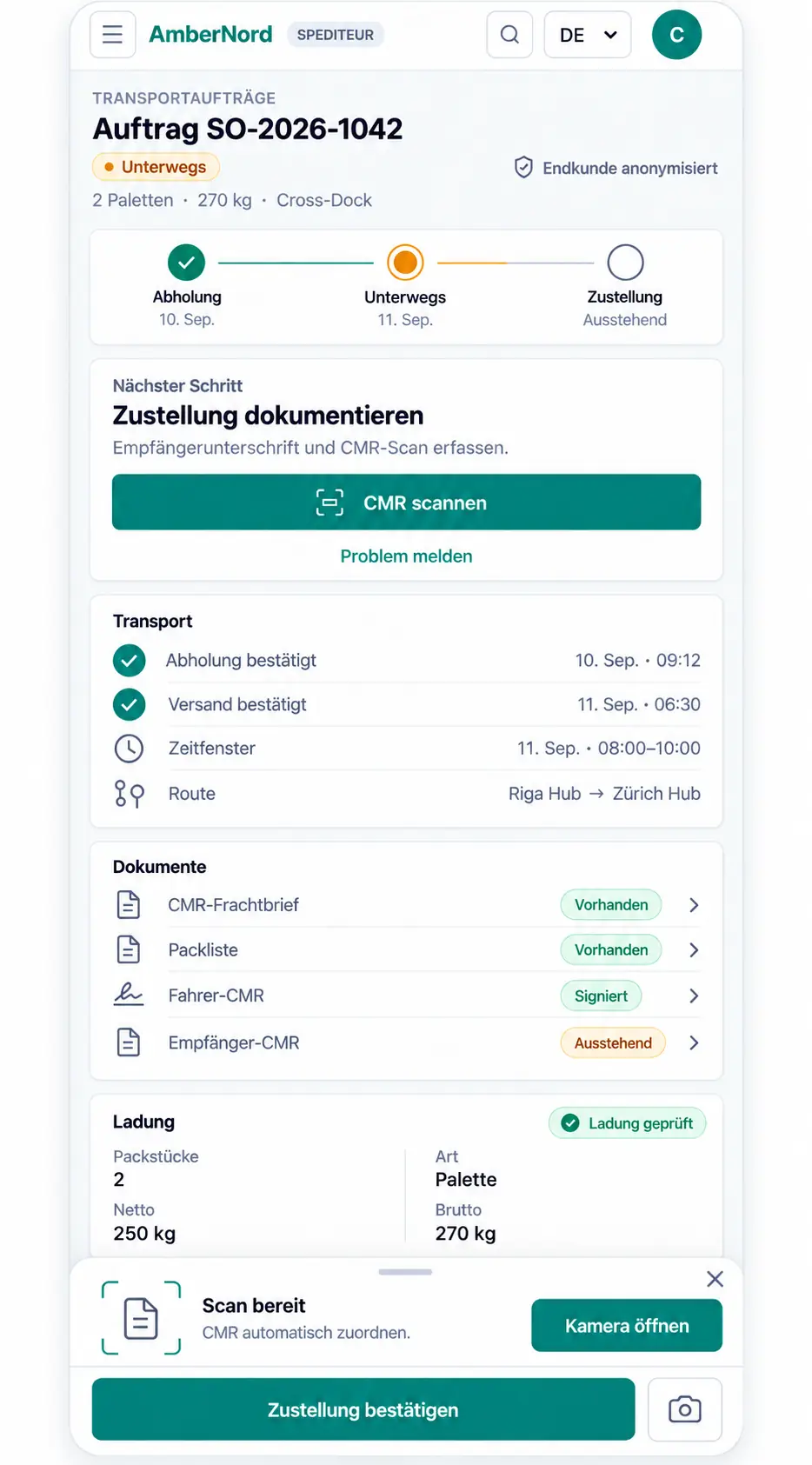
Address, quantity, date, delivery papers. No prices, no contracts, no end-customer names. They confirm pickup and delivery, and everyone else sees the status the same moment.
What the B2B Portal can do
Eight functions that carry an order from enquiry to paid invoice.
Enquiry and offer
The customer submits an enquiry with line items and quantities. The platform replies with a quote that carries validity and terms. Acceptance with one click, and the history stays.
Order with fixed steps
Seventeen states from enquiry to paid invoice, only permitted transitions, and every transition with time and person in the log. The customer sees six understandable stages instead of seventeen internal steps.
Each party sees only its own
Supplier and carrier receive their order as an excerpt: only the fields released for them. Customer roles see the sales price, never the purchase price. These rules live in the code and are tested, not kept in people's heads.
Quality with batches and certificates
Certificates of analysis per batch, specification limits with automatic pass or fail, incoming goods inspection, retained samples. Traceability from delivery to batch and back.
Complaints with statutory deadlines
Visible defects within ten working days, hidden ones within thirty days, warranty 24 months. The portal counts the deadlines and reminds you before they expire.
Invoices across borders
Two invoice chains (supplier to platform, platform to customer), handling of EU triangular transactions, Incoterms, shipping documents as PDF straight from the portal. All versioned and visible to the right party.
Chat in the portal, not by email
One conversation per order, live. Where supplier and customer must not know each other, the platform mediates: messages are passed on without either side seeing the other.
Immutable audit log
Every change to order, price, document or role is appended, never overwritten. There is no function to delete or edit, not even for the operator. When there is a dispute over "who changed what and when", there is an answer instead of a discussion.
How an order runs
Enquire
The customer chooses items and quantities, attaches specifications and sends the enquiry. The platform sees it immediately.
Quote and confirm
The platform calculates with open cost components (goods, transport, customs, insurance, margin) and sends the quote. The customer accepts. The price is frozen as a snapshot.
Produce and ship
The supplier reports production status and uploads the certificate of analysis. The carrier receives only the delivery order and confirms pickup and delivery.
Check and close
Incoming goods checked, invoice issued, paid. The history stays traceable forever, and complaint deadlines run from here.
Under the hood
A portal that four companies must trust cannot make assumptions. So every rule is in the code, and tested.
The anonymisation boundary
Supplier and carrier see the order only as an excerpt that the server builds from an allowlist. What is not on the list does not leave the database. An end-to-end test plays through the three parties and checks that the end customer stays invisible.
Two-factor is built in
Sign-in via authenticator app (TOTP) with recovery codes, the secret stored encrypted. Whether the second factor is mandatory for everyone is up to you. Sessions expire after twelve hours, failed sign-ins are throttled, forms are protected against bots.
State machine instead of free text
A status is not a text field but a defined state with permitted transitions. "Delivered" before "shipped" is impossible. What is impossible, nobody has to correct afterwards.
Prices as a snapshot
Price periods over twelve months, quantity tiers, open cost components. On ordering, the price is frozen. If the tier changes later, the old order stays what it was.
One database, every query checked
All parties work on the same data; there are no copies drifting apart. What a party sees is decided afresh by the permissions layer on every request, by tenant and role.
Data protection as a module
Access requests, incident reporting within 72 hours, list of sub-processors, deletion periods with an automatic run. The interface comes in four languages.
Build-out for your project
What we build on for you
The portal is built for one supply chain and runs there. For your chain, three things are added that are not in the code today. Each at a fixed price after the analysis.
Your parties, your roles
The four tenant types and eleven roles are hard-wired today. We rename them after your chain and add what you are missing, say a second supplier or an inspector.
Four-eyes approvals
Orders above an amount, price changes and cancellations need a second person. Today that threshold does not exist; we build it in with a log.
Import and accounting
Read in item and customer master data from a spreadsheet, export orders as a spreadsheet, connect accounting via interface. Today there is export as PDF; the rest we build.
What you see
The same order from three perspectives: platform, supplier, carrier. What is missing is missing on purpose.
How you get the B2B Portal
As your own installation under your name, with your parties, roles and documents. In the analysis we map your supply chain, define who may see what, and clarify the interfaces. Then you receive a fixed price for setup, adaptation and training.
Setup
Fixed price after analysis
Analysis EUR 300, credited against the order · from EUR 1'500 in installments
Request analysisQuestions about the B2B Portal
Yes. Four is the maximum, not a requirement. Without an external carrier the role stays empty; if you produce yourself, you are supplier and platform in one. In the analysis we define which roles you need and what they are called at your company.
They get an access with exactly the view their role provides. They do not have to learn more than that. The incentive is practical: see the status instead of asking, find certificates instead of searching. Anyone who prefers email gets a short email with a link into the portal at every status change.
We built it for raw materials with batches, certificates of analysis and customs. The mechanics underneath are general: parties, roles, states, documents, log. What is industry-specific, such as the specification limits, we adapt to your goods in the analysis.
More extensions
How many emails does an order take at your company?
Describe your supply chain: who orders, who produces, who delivers, who approves. Within 48 hours you receive an assessment of what the portal covers immediately and what we build on for you.