Extensions AmberNord Fleet · Run
The inspection will happen. The only question is who looks first.
AmberNord Fleet reads the files from driver cards, checks that they are unaltered, and works out driving, break and rest times under EU and Swiss law. Every infringement is in the report with rule, period and the activities behind it, before an authority finds it.
- Signature and certificate chain checked
- EU and Swiss rules
- Original stays unaltered
- Deadlines for card and vehicle
Who we built Fleet for
For operators with lorries or buses who need to understand tachograph data, not just store it. And for the person who wants to know in the morning what went wrong yesterday.
The haulier with twelve vehicles
Driver cards every 28 days, vehicle units every 90 days. Fleet shows what is due, reads in the card files and shows per driver where the week went out of bounds. Before the fine notice arrives.
The dispatcher with drivers in the EU and Switzerland
Two rulebooks: EU Regulation 561/2006 and the Swiss ARV 1. Fleet selects the rulebook per operator or per driver and evaluates with the matching references. The limits live in a table, not in the code.
The operator who wants to get rid of paper
Weekly scheduling, absences, expiry dates for inspection, insurance, tyres, driver qualifications. The driver reports in the morning and evening by phone, with a photo. All in one interface.
What Fleet can do
Eight things Fleet does today with an uploaded card file and your operation.
Read driver cards, Gen1 and Gen2
Files in DDD or TGD format are recognised by content, not by extension. Identification and activities are broken down minute by minute: driving, work, availability, rest.
Verify authenticity, do not assume it
For Gen1 cards, Fleet checks every signed data section with RSA against the card certificate and the chain up to the member state's certification authority. For Gen2 it checks the certificate chain; the data signatures need an authenticated download. If a link is missing, it says "not verified", never "probably fine".
The six rules that cost the most
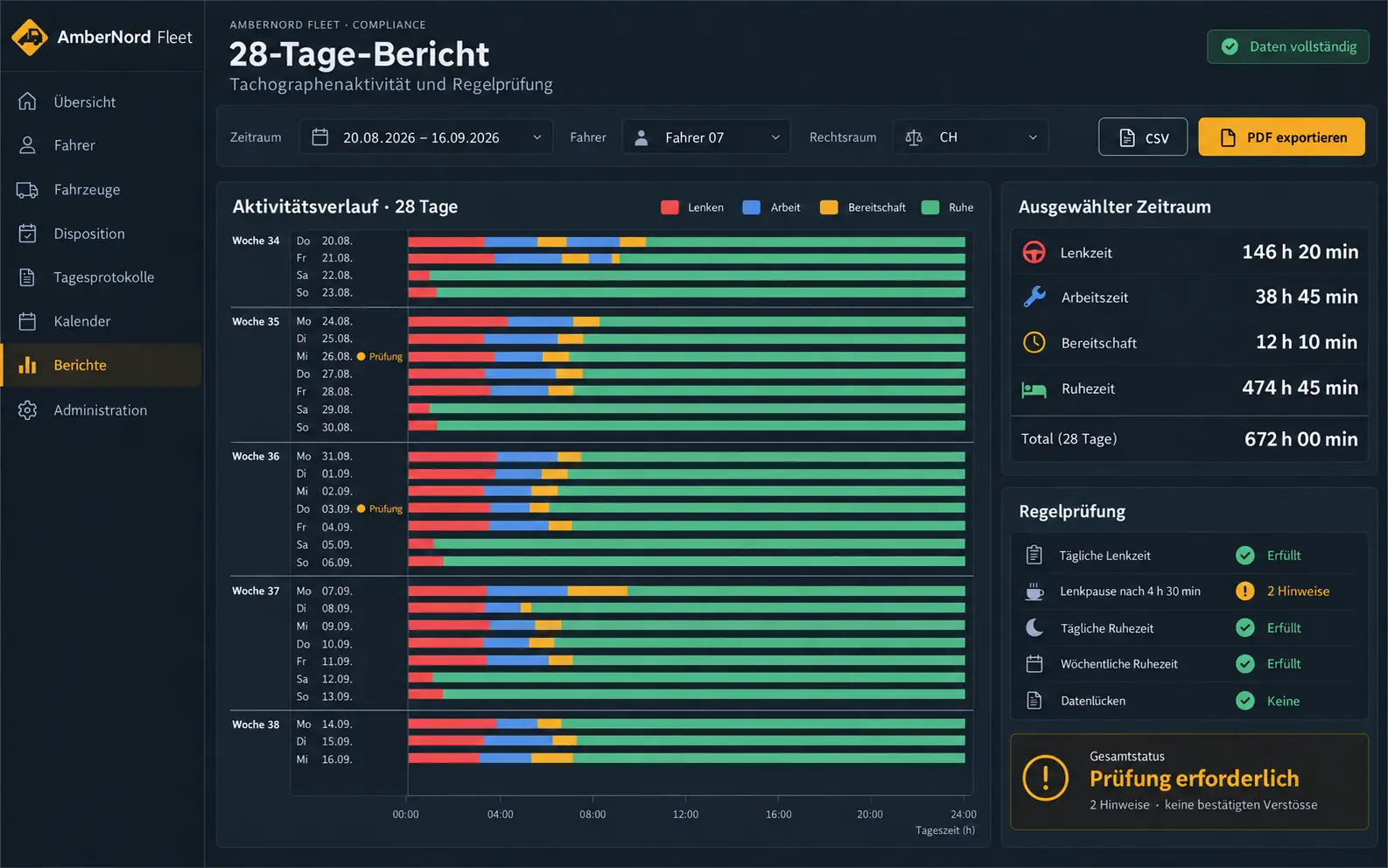
Daily and weekly driving time, fortnightly total, break after four and a half hours (also split 15 + 30), daily and weekly rest. Reduced weekly rest periods are marked as "possible" so that you take a look.
Infringements with evidence
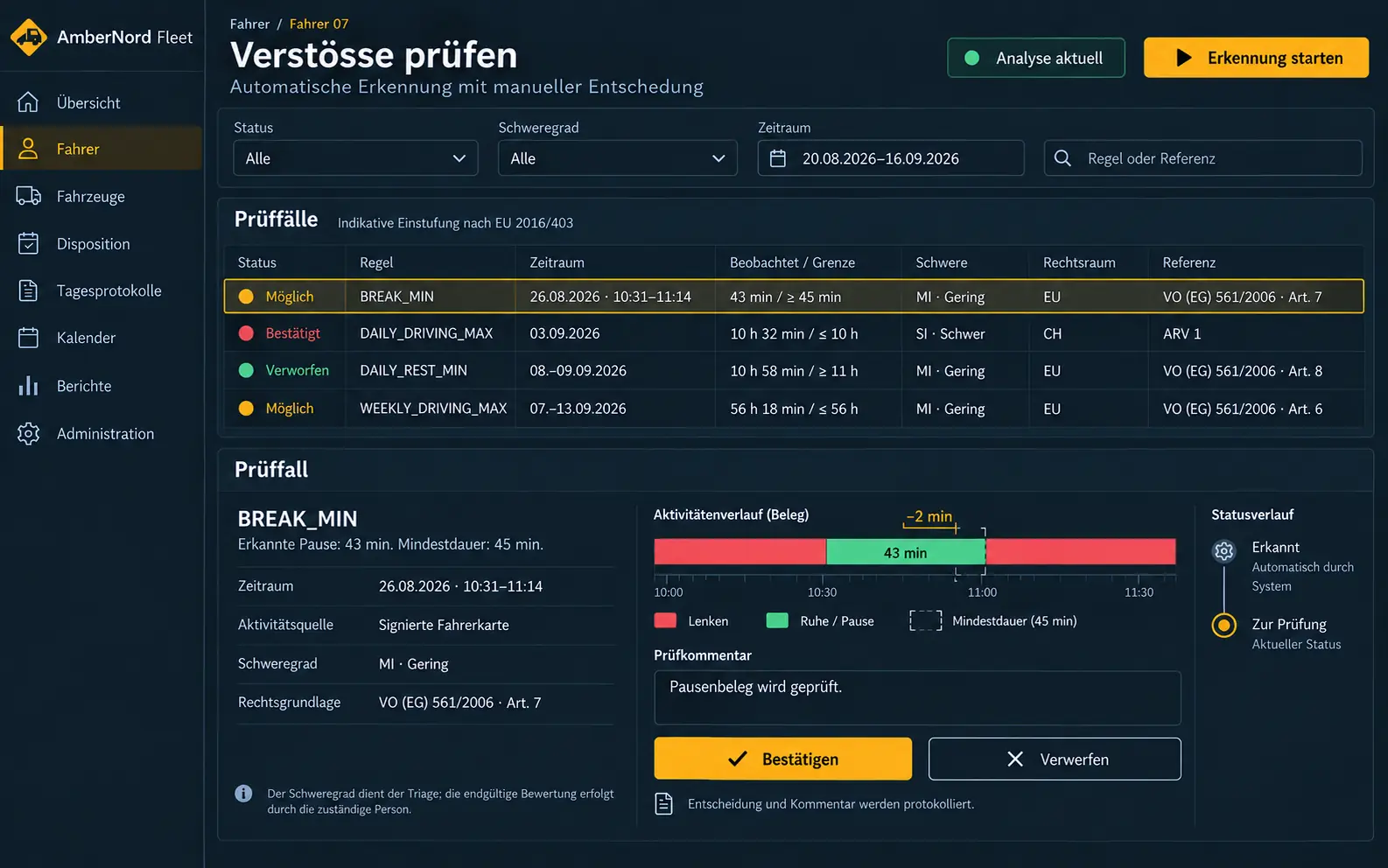
Every infringement carries rule, reference to the legal article, period and the activities it follows from. A four-level classification modelled on the EU pattern helps with sorting; it is a guide, not the official classification.
Deadlines and driver profiles
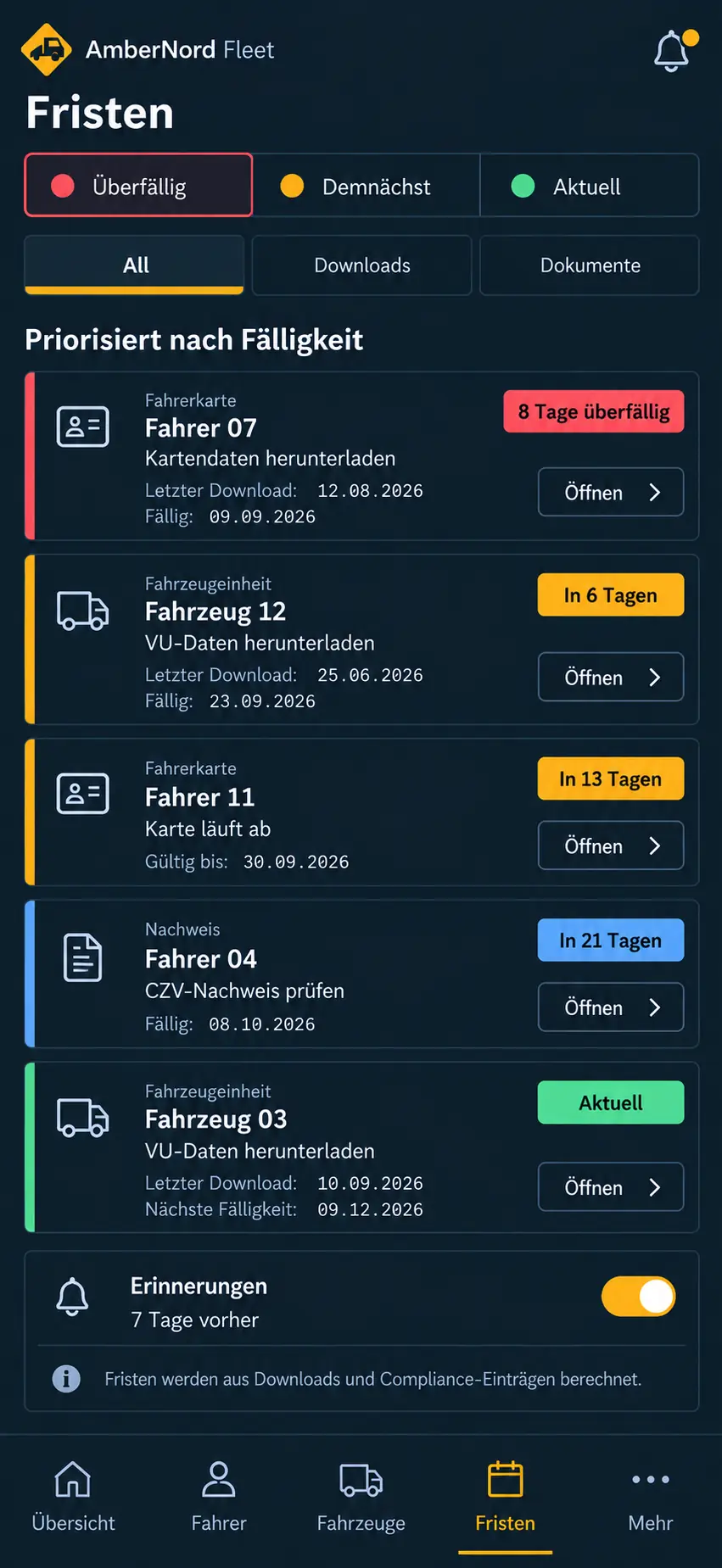
28 days for the card, 90 for the vehicle, warning seven days ahead, visible on sign-in. Driver profiles with card number and expiry date, vehicles with deadlines for inspection, insurance, tyres, plus driver qualifications such as ADR or medical certificate.
Reports to hand on
Filtered report as PDF or CSV, per driver or for the fleet. One PDF per infringement. A driver meeting as a signable letter. For the meeting, for accounting, for the authority that asks.
Scheduling and absences
Weekly plan driver x day x vehicle. Double booking, an expired qualification or a vehicle without a valid inspection are blocked while planning. Holidays and sick leave flow into availability.
Driver app and corrections
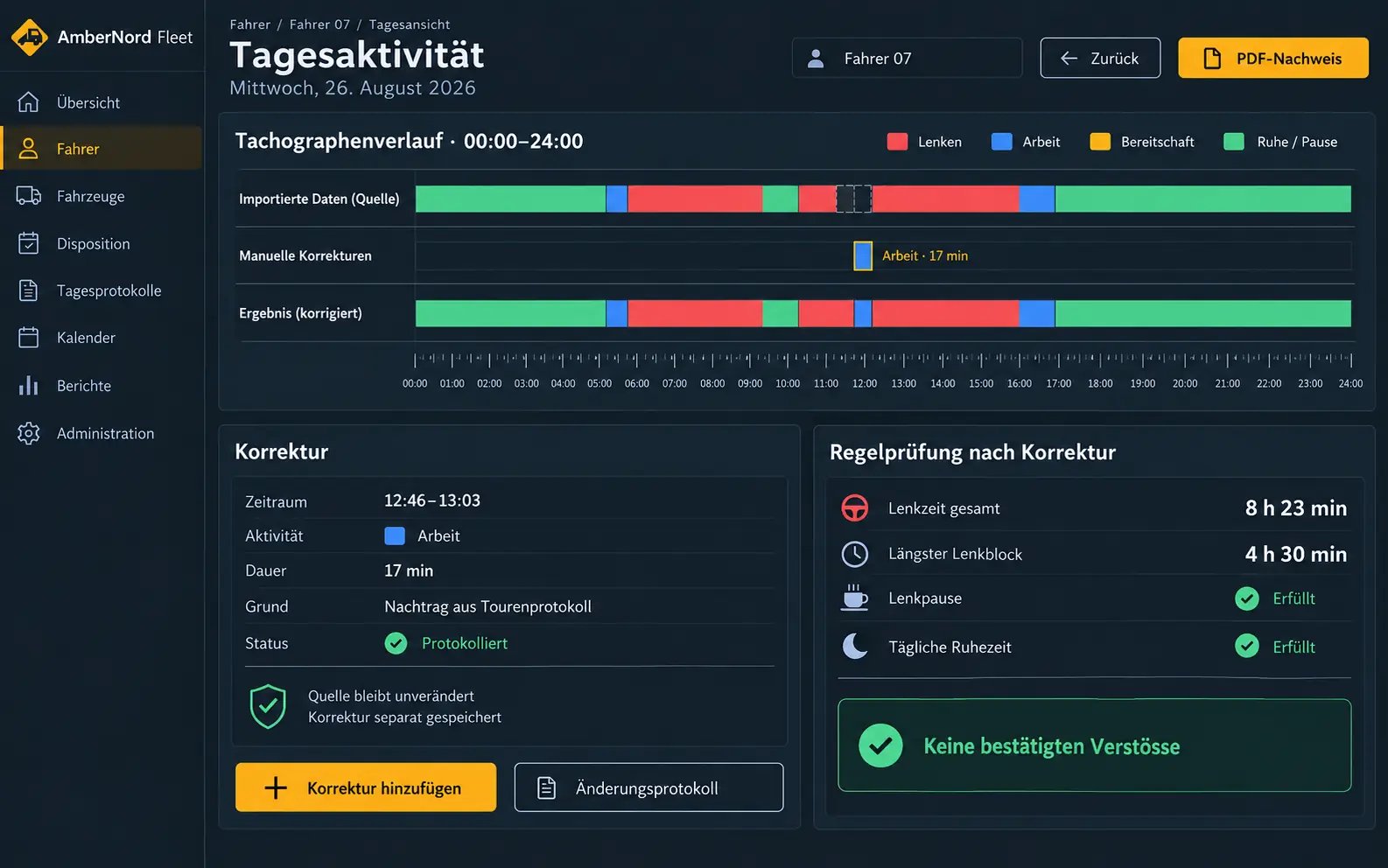
The driver signs in on the phone via a one-time link, sees their week and sends daily logs with a photo. Corrections sit as a layer over the original file; the file itself is never touched, and infringements are recalculated on the corrected view.
How an analysis runs
Upload the file
From the card reader or the download device, via browser. Fleet recognises card type and generation by content.
Verify and decode
Signatures and certificate chain, then the activities down to the single minute. The original file is stored and never altered.
Evaluate
Your operation's rulebook runs over all activities. Infringements appear with rule, evidence and period on the timeline.
Report and act
Driver report for the meeting, fleet report for management, CSV for accounting. The next deadline is already on the list.
Under the hood
Tachograph data is evidence. Fleet treats it that way, from the first byte to the report. And we say openly what it cannot do yet.
Parser built against the specification
Every data block on a card is defined in the EU implementing regulation. Fleet reads by that definition, field by field, and was validated on a real driver card with 1'220 activity periods.
Signature checking without wishful thinking
Gen1 is checked with RSA under ISO 9796-2, Gen2 via the certificate chain up to the member state's certification authority. We store the European root certificate when setting up your operation. Without the root, Fleet reports "not verified", never "valid".
Rules as a table, with versions
Limits live in a table per rulebook. Changes are proposed, activated and can be rolled back. If the source changes, Fleet detects it by a hash and never writes into the active limits on its own.
One installation per operator
Fleet runs for your operation in its own account, with its own database and its own storage. No one else's data sits next to it. Access through roles: superuser, admin, user, viewer, with individual rights for scheduling, corrections and approvals.
Originals stay originals
The uploaded file is stored and never altered. Evaluations are derived data and can be recalculated at any time, for instance after a change in the law, without touching the evidence.
Retain and delete by rule
A retention and anonymisation run, off by default, with a dry run that shows what it would delete. Changes to drivers, vehicles, corrections, users and exports are in the log.
Build-out for your project
What we build on for you
Fleet today runs in one language and reads driver cards. Three things are still missing, and we build them into your installation at a fixed price.
Evaluate vehicle units
Files from the vehicle unit are stored today and their deadline tracked, but not broken down. We build the parser for events, faults, speed and calibrations.
More rules, German and French
Ferry rule, multi-driver operation, compensation of reduced rest periods, working time directive, night work. And the interface in your language: today it runs in one.
Checksum and calendar
Every file gets a checksum on upload, every upload a log entry. And the deadline list becomes a calendar you can sync with your own.
What you see
Timeline, infringement list, deadlines. Three views from the application.
How you get Fleet
Fleet is set up as your own installation for your operation, with your rulebook, your drivers and vehicles and your report templates. In the analysis we clarify fleet size, rulebook, card readers and language. Then a fixed price for setup and training; ongoing support depends on the size of the operation.
Setup
Fixed price after analysis
Analysis EUR 300, credited against the order · from EUR 1'500 in installments
Request analysisQuestions about Fleet
For evaluating and archiving driver cards: yes. For downloading from card and vehicle you still need a card reader or download device. Files from the vehicle unit Fleet accepts today and tracks the deadline; the detailed breakdown is something we build on.
Yes. Fleet keeps EU Regulation 561/2006 and the Swiss ARV 1 as separate rulebooks with their own legal references. You choose per operator or per driver which one applies, and the report names it.
The authority checks the original files. Those are exactly what Fleet keeps unaltered and hands over on request. The reports are your evaluation: they show that you checked and acted, and that counts when a fine is assessed. They do not replace legal advice.
More extensions
How many driver cards sit unread in your office?
Tell us your fleet size, area of operation and current solution. Within 48 hours you receive an assessment of what the analysis would clarify and what the setup costs.